

Reframing Sustainability
Using truthful statements to deceive others.

A year ago, I started SustainLab with a 2015 image of U.S. Senator Jim Inhofe (R-OK) about to throw a snowball. He was standing on the Senate floor speaking against the well-established science of climate change. Among his arguments was that it was unusually cold that week (never mind that a change in the weather is different than a changing climate).

People who study rhetoric call deceiving others with truthful statements paltering, which was one of many rhetorical devices used by Senator Inhofe (1934-2024) in his arguments against climate change.
Now, an international team of researchers have used artificial intelligence (A.I.) to reveal paltering—among other rhetorical devices—as part of an overall increase of climate contrarian speeches in Congress from 1994 to 2024.
Without understanding why people palter, however, confronting them with their deception may backfire, prompting them to strengthen their original views. In turn, that could escalate conflict as those who palter may then palter more or even shift to spreading disinformation—lying by commission—to reinforce their worldviews.
Analyzing Congressional Speech
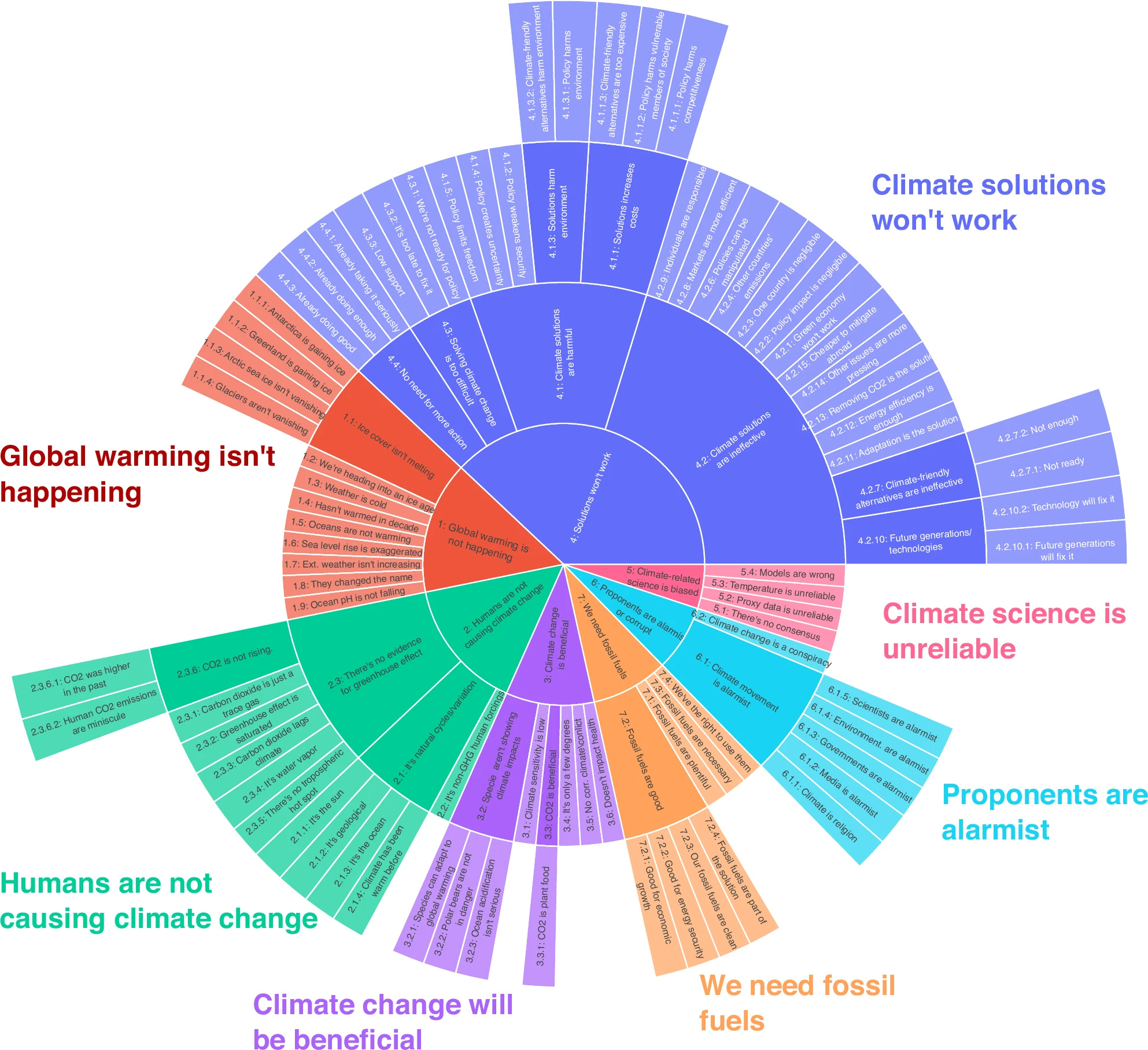
In the research paper, “Large language model reveals an increase in climate contrarian speech in the United States Congress” (Communications Sustainability, 27 February 2026), the authors used publicly available tools to extract the text from the digitized public record of congressional speeches. They then used large language models—a type of A.I.—to separate climate-related vs. non-climate related paragraphs, finding 110,837 paragraphs out of 2,515,806 paragraphs spoken over the 20-year period. They then categorized the rhetorical statements being used against addressing climate change.
This research was building on a previous study (2021) that examined text from conservative think tank websites and climate-contrarian blogs. Those researchers created a taxonomy of contrarian claims.
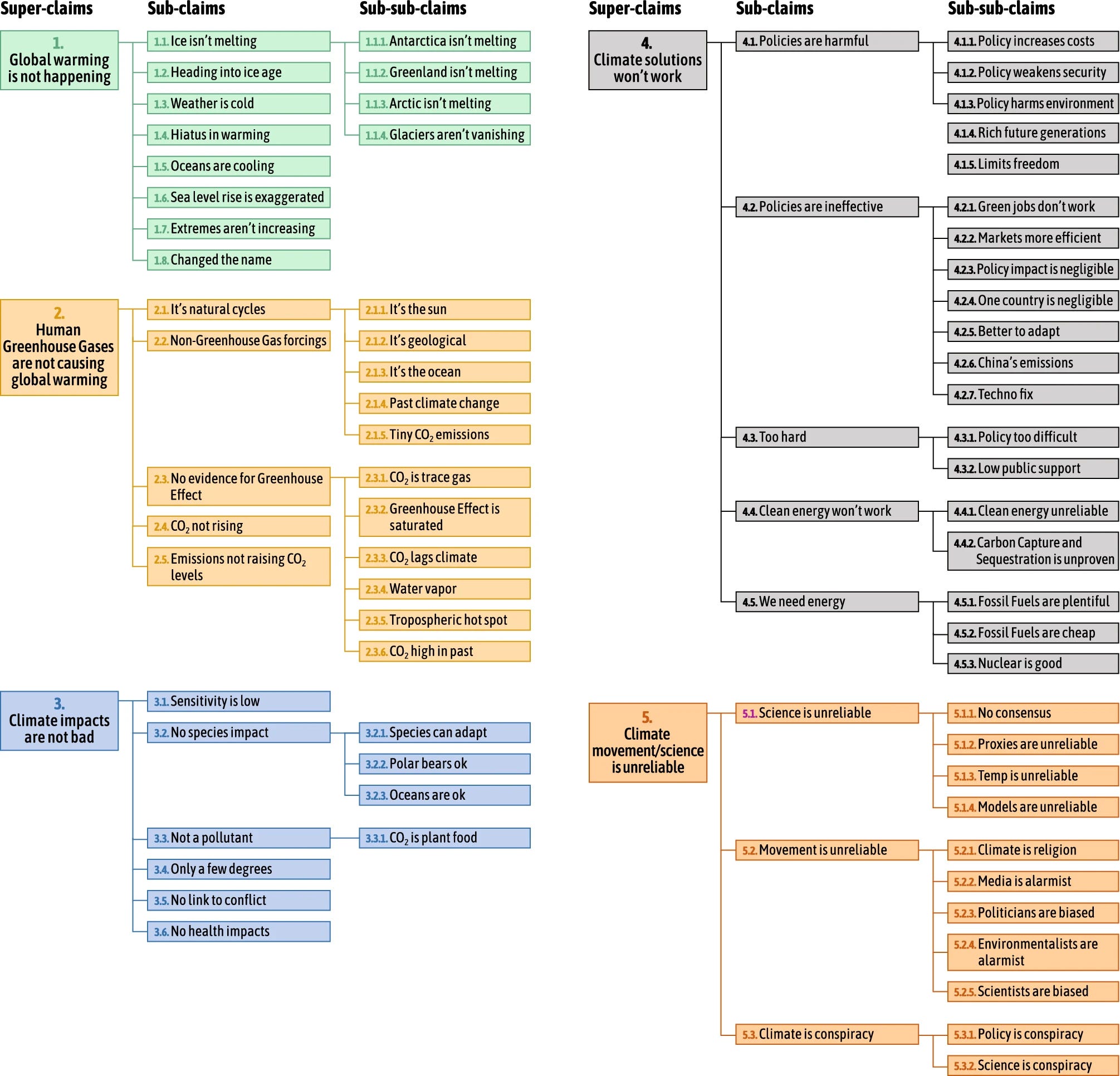
The new researchers — using congressional speeches — revised the 2021 taxonomy to:
make substantial additions to category 4 (“Climate solutions won’t work”),
split category 5 (“Climate movement/science is unreliable”) into two categories (so added category 6: “Proponents are alarmist”), and
add a new top-level (“super-claim”) as category 7: “We need fossil fuels.”
“These adjustments” wrote the authors of the 2026 study, “substantially improved the classifier’s ability to assign accurate labels across the revised taxonomy, resulting in a more robust and discriminative classification system.”
Indeed, before turning to A.I. to go through the 2,515,806 paragraphs spoken by members of Congress over that 20-year period, the researchers had people—“classifiers” also referred to as “the human gold standard”—assign labels to a sample of the paragraphs from congressional speeches.
In sum, then, the researchers in 2026 added 28 climate contrarian claims to the previous taxonomy. Those additions made the people (“classifiers”) better at classifying statements from members of Congress. Then the researchers gave all 2,515,806 paragraphs to A.I. to find the 110,837 paragraphs related to climate claims.
In the list below of the 28 newly classified claims, the numbers (e.g. 4_1_1_1) refer to the claim location on the researchers’ circle diagram (previously given above):
4_1_1_1 Climate policies will harm economic competitiveness
4_1_1_2 Climate policies will kill jobs and/or harm vulnerable members of society
4_1_1_3 Climate-friendly technologies and practices are too expensive and/or uneconomical
4_1_3_1 Government climate policies will harm the environment, habitats, and/or species
4_1_3_2 Climate-friendly technologies/practices will harm the environment, habitats, and/or species
4_1_4 Climate policies create economic uncertainty and may have unintended consequences
4_2_6 Climate policy can be gamed or manipulated
4_2_7_1 Climate-friendly technologies are not ready
4_2_7_2 Renewable energy cannot provide base-load power and is difficult to scale
4_2_9 Individuals/consumers are responsible for climate change and should change their behavior to solve it
4_2_10_1 Future generations will be richer and will be better able to solve climate change
4_2_10_2 Future technology will fix climate change, so we shouldn’t worry too much
4_2_12 Increasing energy efficiency is enough to meet the challenges of climate change
4_2_13 We should focus on carbon dioxide removal rather than emissions reductions
4_2_14 There are more pressing problems than climate change and we should address those first
4_2_15 It’s cheaper to mitigate climate change abroad, so we are better off focusing on helping other countries reduce their emissions
4_3_1 We don’t have the right policy to solve climate change and/or need to better understand all the implications before implementing climate policies
4_3_2 It’s too late to do anything to mitigate climate change
4_4_0 We have already made a lot of progress on climate change and don’t need to do anything else.
4_4_1 We are already taking climate change seriously, so there is no need to worry
4_4_2 We are already doing enough to address climate change, so there is no need for more action
4_4_3 We are already contributing enough to the societal good we don’t need to also address climate change issues
7_2_1 Fossil fuels are important for economic growth and development. (Assigned when text explicitly links fossil fuels to economic growth/development)
7_2_2 Fossil fuel extraction is important for energy security. (Assigned when text emphasizes the importance of fossil fuels for domestic security or energy independence.)
7_2_3 Our fossil fuels are cleaner than others
7_2_4 Fossil fuels are part of the solution. We need to transition to cleaner fossil fuels.
7_3_0 Fossil fuels are necessary to meet energy demand. This includes, but not limited to, arguments that we need all forms of energy, including fossil fuels.
7_4_0 We have a right to profit from fossil fuels just like others have
On their own, many of these newly classified contrarian claims appear to be examples of paltering, which again means using true statements to deceive others.
For example, it is true that (7_2_3) “Our [American] fossil fuels are cleaner than others.” It’s particularly true of coal from China. So, one argument goes, it’s better for the Chinese to burn American coal than to dig and burn their own. But such true statements, as the authors write, often “withhold the broader context in order to portray a misleading expression.” Some broader context, then, for that argument about why China should be burning American coal instead of its own: unlike the United States, which is embracing more fossil-fuel use under the Trump Administration, China is transitioning its energy system to renewables, and so even as China’s energy demands have gone up, its emissions recently dropped. So although China is the world’s largest emitter of greenhouse gases, producing twice as much as the U.S., it also has four times the population. That means the average person in China emits far fewer greenhouse gases than the average person in the United States. So in combination with (7_2_4) “Fossil fuels are part of the solution. We need to transition to cleaner fossil fuels,” a member of the U.S. Congress has a powerful set of paltering arguments to advocate for continued coal mining and export.
Paltering
It is impossible to know what prompts paltering among any particular person, including members of Congress. But research on paltering suggests many people who palter don’t see it as wrong. That’s even though those on the receiving end rate paltering the same as lying by commission (i.e., purposefully using false statements) with people considering it “especially unethical when palters are used in response to direct questions as opposed to when they are unprompted.”
Parent: “Did you finish your homework?”
Kid: “I wrote an essay for my English class.”
... then after parent finds out kid is not done with homework...
Parent: “Why did you answer my question that way?”
Kid: “What I said is true.”
Parent: “But you misled me.”
—an example of paltering in response to a direct question
One reason researchers think that palterers don’t see paltering as wrong—or see it as less wrong—is because the paltering is done in their own self-interest. Doing so discounts the misleading consequences and/or attributes the fault for the deception to the person who was deceived (‘who should have paid closer attention’). In other words, deception by paltering helps a person “delude themselves of their own integrity.” To put it another way, to palter and delude oneself about one’s own integrity is a kind of incompetence in moral or ethical reasoning about which people themselves often are unaware.
When people are incompetent in the strategies they adopt to achieve success and satisfaction, they suffer a dual burden: Not only do they reach erroneous conclusions and make unfortunate choices, but their incompetence robs them of the ability to realize it. Instead… they are left with the mistaken impression that they are doing just fine.
— From Unskilled and unaware of it: How difficulties in recognizing one's own incompetence lead to inflated self-assessments, Kruger, J., & Dunning, D. (1999).
Contrarians About Climate Change
So what to do? Few people will take well being told their paltering is evidence of their incompetence in reasoning about morals or ethics!
Researchers suggest instead using two strategies: name the negative consequences of the lie and cite reasons the person being deceived doesn’t deserve being lied to.
To get to that point, though, means detecting the paltering in the first place, which is often a matter of asking for clarification.
Parent: “Did you finish your homework?”
Kid: “I wrote an essay for my English class.”
Parent: “Was that all you had to do?”
Kid: “I also did my math worksheet.”
Parent: “That gives me the impression that you finished your homework, but is that what you're saying?”
Kid -- unwilling to lie by commission -- "No, I'm not finished with my homework."
Parent: "So... I'm going to have to challenge every statement you make until you earn my trust back because I can't trust you not to deceive me. C'mon, kid, I try to be a good parent, and I work hard to give you with every opportunity I can afford. Is there something I did that makes you think I deserve to be lied to?
Of course, someone paltering may switch to lying by commission, but then that person can no longer delude themselves about their own integrity.
Climate change contrarians in Congress, however, rarely lie by commission anymore. That’s especially after 2015 when the U.S. Senate voted 98-1 acknowledging that climate change is real and not a hoax.
So yes, even the U.S. Senate agrees on one of the “Six Key Truths” — “It’s real” — identified by communications researchers as having “potential to help build public and political will for climate solutions.”
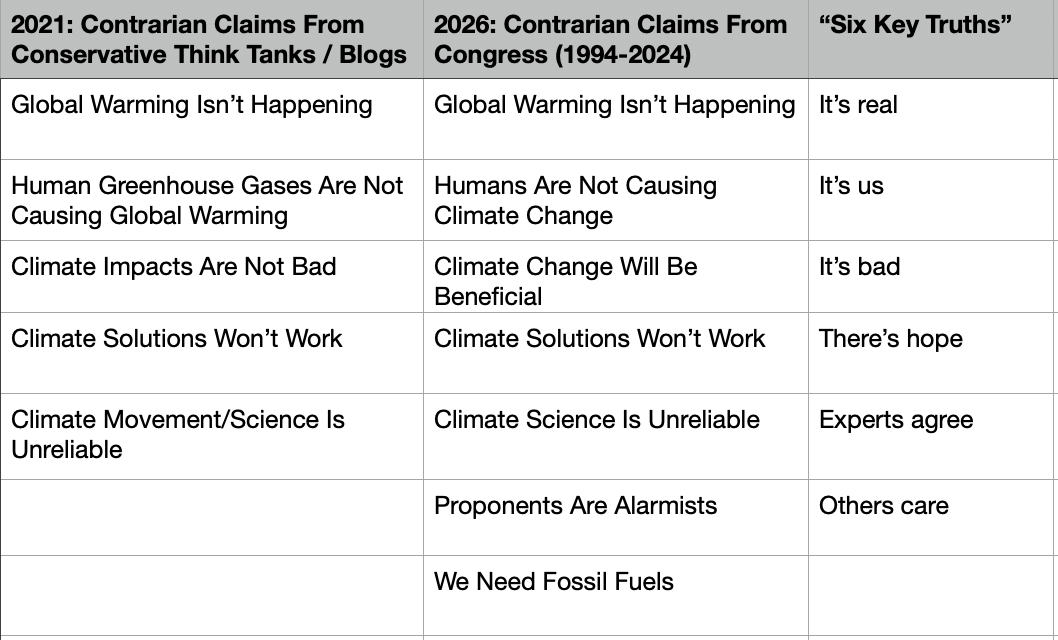
The super-category of contrarian claims not addressed by the six key truths — “We Need Fossil Fuels” — is an old argument. It was first made by people with well-known names that have since been remediated by the foundations built from the wealth they amassed in the fossil-fuel industry, such as Kettering, Sloan, and Rockefeller.
Kettering was head of research for General Motors, and one of his engineers, Midgley, had discovered adding tetraethyl lead to gasoline eliminated engine knocking. Kettering reported it to Sloan, GM’s CEO, whose company contracted with Standard Oil (Rockefeller) to put lead into gasoline in 1923. The discovery was even called a “gift of god.” Knowing, however, about the toxic effects of lead, the leaded gasoline was marketed as “ethyl.”
Scientists and doctors were soon concerned. As Naomi Oreskes recounts the story in a book review in Scientific American (2024):
In 1925 the surgeon general organized a conference of businesspeople, union leaders, scientists, doctors and government officials to consider the matter. Given what Midgley told the surgeon general, one might expect the representatives of American industry to have insisted that lead in gasoline was safe. Instead they argued it was essential for the U.S. economy, for industrial progress, for the American way of life.
It took decades of documenting health and environmental effects, the subsequent creation of the Environmental Protection Agency, and the passage of the Clean Air Act before oil and gas companies were required to remove lead from gasoline. In the U.S., it wasn’t until 1996 that leaded gasoline was completely banned. But the world didn’t finally stop using leaded gasoline until 2021.
Paltering Influence?
The 98-1 vote in the U.S. Senate — that climate change is real and not a hoax — came a month before Senator Inhofe brought that snowball to the Senate Floor. Senator Inhofe had voted as part of the 98, but said “The hoax is that there are some people that are so arrogant to think that they are so powerful that they can change climate.”
In those same discussions on 21 January 2015, before the vote, Senator Sheldon Whitehouse (D-RI) noted the day of their discussions was the fifth anniversary of the U.S. Supreme Court (5-4 ruling) Citizens United v. Federal Elections Commission, which enabled unlimited spending by corporations and other outside groups on electioneering communications.
It is perhaps a telling coincidence that we’re having this conversation on the floor of the Senate now on the fifth anniversary of the Citizens United decision. Because before Citizens United came along, there was actually a pretty robust conversation between Democrats and Republicans about carbon pollution and climate change and what needed to be done about it.
Fourteen years after the Citizens United decision, in 2024, oil and gas industries spent $219 million to influence the outcome of the election, with most of it to support Republicans.
By around the same proportions, Republican members of Congress made far more climate contrarian claims than Democrats did from 1994 to 2024.
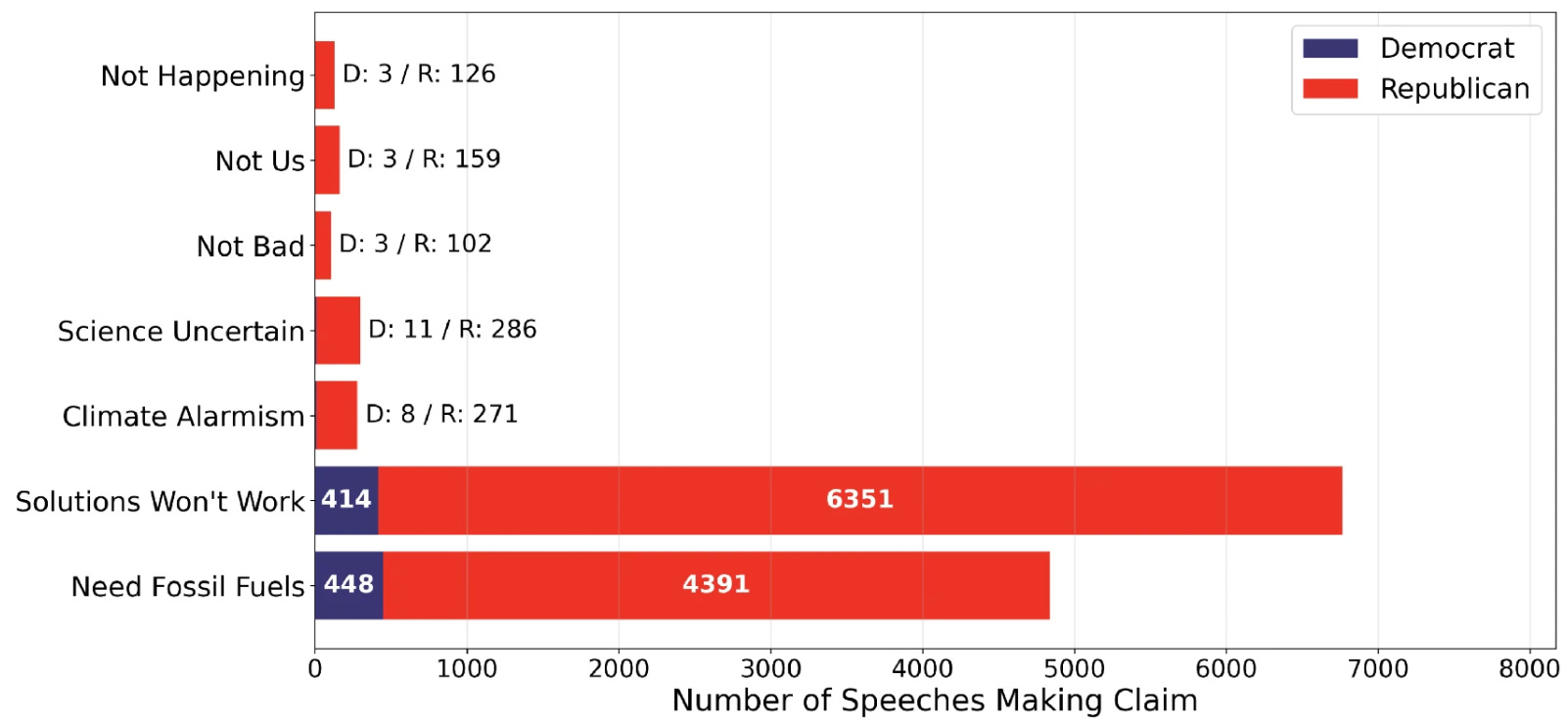
Critically, however, the researchers wrote in their 2026 paper: “Statistical analysis further suggests that demographic factors and district-level fossil fuel employment predict claims making in floor speeches.”
Indeed, it is paltering to discount the need to address climate change by saying “Fossil fuels are important for economic growth and development” (7_2_1). But there’s no denying the truth of that statement itself for as long as the U.S. lacks the political will to transition away from fossil fuels.
If you, like me, are a citizen of the United States — whatever your political persuasion or ideology — please keep your sustainability focus local, but also consider contacting and urging your representatives in Congress to undertake the persistent action needed, over long time scales, to transition away from unsustainable fossil fuels.
"In other words, deception by paltering helps a person 'delude themselves of their own integrity.' To put it another way, to palter and delude oneself about one’s own integrity is a kind of incompetence in moral or ethical reasoning about which people themselves often are unaware."
One of my favorite psychological theories is Sperber & Mercier's argumentative reasoning.
"According to this theory, the main functions of human reason would be social: to produce and evaluate arguments and justifications in dialogic contexts. The theory makes sense of otherwise puzzling features of human reason--the myside bias and other failures of individual reasoning, as well as the successes of argumentation"
https://sites.google.com/site/hugomercier/reasoning
"Oh, what a tangled web we weave, when first we practice to deceive." Sir Walter Scott
Thanks for teaching me a new word; I shall be on the watch for the behavior.