

Sustainable Dissent
How might we address structural/slow violence before it does harm, but before we need a hero?

This week, the Society of Environmental Journalists gathers in Chicago for its annual meeting bringing together “journalists, scientists, government officials, advocacy leaders and others to explore the many facets of environmental stories in order to improve the quality and accuracy of environmental reporting.”
The business of environmental reporting, however, is often incompatible with environmental stories about “structural” or “slow violence” over time. Such environmental stories are current events, such as long-term pollution or climate change. But they are not news in the traditional sense and are never “breaking news.” So these kinds of environmental stories do not—perhaps even cannot—attract the kind of attention that, say, environmental reporting about a stranded whale can.
Indeed, we adapt to the structural/slow violence going on around us, sometimes even poking fun at ourselves or others for, say, “normalizing copious amounts of insanity.” There’s an important distinction, though, between normalizing and desensitizing. But without making this distinction and attending to our evolutionary advantageous capacity for desensitization, the attempt to cover structural/slow violence stories can backfire: instead of prompting interest, such journalism may prompt fatigue, annoyance, and even anger. So finding journalistic ways to cover structural/slow violence takes courage and a strategy to maintain it. It’s kind of like dissenting from a group even though everyone in the group agrees that great minds don’t always think alike.

Normalizing versus Desensitizing
Pictured above is a famous example of normalizing waste and consumption. The article, “Throwaway Living,” appeared in the 1 August 1955 issue of Life magazine. Seventy years later, I wonder if any of those throwaway items are floating in the ocean or have broken up into microplastics, with some of those pictured plastics—now as tiny particles—literally circulating in my bloodstream doing structural/slow violence to my body.
Another famous example of normalizing comes from the U.S. presidential campaign of 2016, where normalizing in the media lifted Donald Trump up and tore Hillary Clinton down, with Trump having done significant structural/slow violence to our body politic and increasingly to our environment.
The hand-wringing over Trump’s normalization began in earnest in the wake of the May 4 Indiana primary victory that drove the last of his serious Republican rivals from the race, which in retrospect was the moment his normalization became all but inevitable. The day after the primary, Vox’s David Roberts predicted that within the “whole superstructure of U.S. politics built around two balanced sides” — the media, consultants, parties and the like — “there will be a tidal pull to normalize this election, to make it Coca-Cola versus Pepsi instead of Coca-Cola versus sewer water.”
— Charles Homans, The New York Times Magazine (1 November 2016)
In contrast to normalization, desensitization is evolutionarily advantageous: it allows a person not to be bothered by the presence of sewer water while still recognizing it’s not normal and so something should be done about it. Medical doctors are trained to become desensitized to the presence of blood and gore while the rest of us subconsciously give our attention to most anything colored red. Surgeons are further trained to become desensitized to their own violence of cutting into another person, which helps surgeons concentrate on solving the problem at hand, whether removing an about-to-burst appendix, bypassing a blocked artery, cutting off a gangrenous leg, or repairing damage caused by a foreign object such as a bullet. People in other professions also undergo desensitization training, such as first-responders, military, police, pilots, and social workers. But chefs, musicians, entrepreneurs, and designers also undergo and benefit from desensitization training, with some of these training situations even turned into various forms of entertainment.
For rest of us, though, we become desensitized not through training but from repeated exposure to something unpleasant, such as long-term pollution, climate change, and other forms of structural/slow violence.
Backfire Avoidance
For those of us in the business of informing people about structural/slow violence and the consequences thereof, journalism and communication researchers say long, drawn-out coverage of such issues can cause both fatigue and annoyance, with some people “particularly negative about the lack of progress.” Of course, individual tolerance to repetition-without-progress varies. But so do people’s views about the importance of covering some issues, such as the environment. So researchers also note that news users who do value such long, drawn-out issues may “avoid the [long, drawn-out] issue during news selection and exposure.”
After all, gone are the days when deciding “what is newsworthy” on a daily or hourly basis was done by reporters, editors and publishers in a format printed, produced, or delivered by a select few publishers in print, radio, or television. Now we can choose our news on a second-by-second basis with the journalism business increasingly employing internet metrics to gauge audience interests and some outlets even employing artificial intelligence to respond faster, for example, to what’s happening in financial markets or trending on social media. (And there’s still much to study about what news influencers are doing in the information ecosystem.)
But publishing environmental stories covering long-term pollution or climate change becomes increasingly hard to justify when even news users who value environmental coverage—myself included—may avoid such stories and so generate fewer “likes” or “clicks,” spend less “time on page,” and generate higher “bounce rates” away from such stories.
About People: Do We Have To Wait For Harm?
So the typical strategy journalists use to cover structural/slow violence is to tell a story about people who are harmed. This strategy borrows on the trope “if it bleeds, it leads” the news coverage of the week, day, minute, second. That journalism strategy gets wide attention by people not desensitized to other people’s harm, which is most of us. So it feeds the analytic machines that inform the modern business of journalism.
For environmental journalists, that means covering people already harmed by long-term exposure to pollution or by climate change. But it also comes up with journalists covering, for example, the many kinds of causalities from bad investment strategies, or political corruption, or any of the many other ways people are obviously harmed—after the fact—by structural/slow violence.
But do we have to wait for there to be someone harmed? Alternately, do we have to find some person—academic, advocate, politician—and report a hero story about their efforts to address the structural/slow violence? What if there aren’t any heroes yet because the structures for violence are just being put into place with, say, known slow violence to come decades later? That was the case with this set of award-winning stories about decades of violations about the release of toxic air pollutants. Imagine such watchdog reporting resulting in stopping the release of toxic pollutants before they did such harm!
Journalists I’ve spoken to about this topic range widely in their responses. But one recently made me, unwittingly, the focus of her article on the structural/slow violence done by government officials who fail to produce public records. Although many public reactions to her article and my efforts were as the aforementioned researchers noted—fatigue, annoyance, anger—there was also, to my delight, encouragement. Subsequently, the story was expanded into (so far) a three-part series, with the latest part reporting on the newly elected Mayor coming forward to say she too has trouble getting public records from her own Town Manager!
In the highly segmented media landscape, where serious journalism competes with “oddities,” that encouragement suggests to me there’s an audience for watchdog journalism stories about structural/slow violence before irreparable harm is done. Although it feels like—as a journalist—I am dissenting from my fellow journalists in this endeavor, that’s OK because even great minds don’t always think alike. The question remains, though, in finding a way forward that is sustainable in all its various forms, including avoiding becoming “particularly negative about the lack of progress.” Indeed, right now, staying informed about the world has me feeling like I’m holding my breath. That’s something I’m learning to recognize as “good” — it’s a signal that I should do something about it — but I sure could use some desensitization training.
A final note of encouragement:
Last week, North Carolina Governor Josh Stein proclaimed 9 April as the state’s “Local News Day,” with the first reason given that “Americans overwhelmingly say local news is the most important and most trusted source of news.”
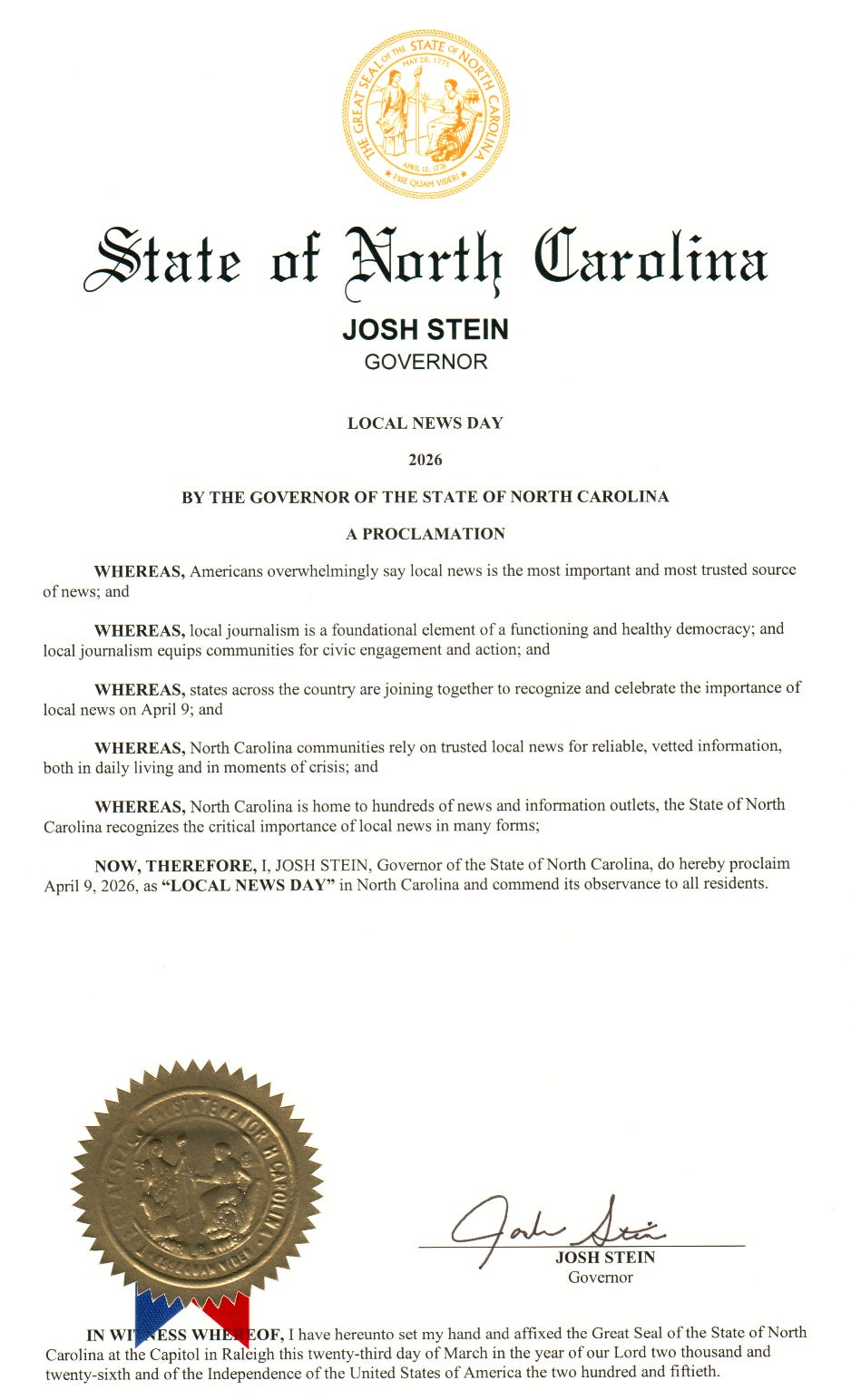
It was part of a national effort coordinated by a number of news organizations.
I wrote all the local news organizations — particularly all those I subscribe to — about joining in. None of them did. But I’ll keep after them, and perhaps they will next year.
Appreciate this post but are thinking “No, I do not need another subscription, another newsletter, another micropayment to keep track of”? I get it. Please consider getting me a virtual coffee or contributing to my virtual tip jar.
Another interesting review of the challenges we face in determining what is "true." I'm happy for you that the articles on requesting public records are continuing.
I was in Jamestown last weekend helping with a clean-up of Richland creek.
https://substack.com/home/post/p-193282837
I'm not an expert on these issues. I'm more of a clown waving a rubber chicken (or in this case a plastic dinosaur) and saying "look over here!"