

In Trust We Trust
Producing records improves trust and, in turn, sustainability, but sometimes watchdogs have to bark and even bare their teeth.

Earlier this month, I attended the annual Society of Environmental Journalists conference at which a solo presenter spoke to a crowded room about “How to Be an Everyday Investigative Watchdog.” I think every journalist is a watchdog, monitoring institutions, politicians, and other public figures with the aim of ensuring transparency and accountability. But the presentation speaker—an Investigative Reporters & Editors Training Director—added “everyday investigative” to his session title. At first, that seemed contradictory: Investigative reporting takes time; to do so everyday sounded like it could be done in less time than is needed. But the “how to” session instead provided tips on breaking the large tasks of investigative reporting into everyday activities.
One basic tip—to become familiar with records retention policies—stood out to me because of recent events in my community and country.
Many governments write such records retention policies into their laws, which gives not only information about how long records are to be retained but also what records even exist. For example, the state of North Carolina provides a legal framework for what records local municipal governments should retain.
But, in my community, and as reported the day the SEJ conference started, the Mayor of Jamestown, North Carolina, has waited months just for a copy of her own town’s records retention policy (never mind those of us waiting for other public records). The Town Manager—an unelected, appointed government official—is not complying.
When government officials so clearly do not follow the law—a betrayal of the public’s trust—problems compound. In Jamestown’s case, the more that public records requests are delayed or unfilled, the more people request public records. As a result, Jamestown’s staff capacity to fill public records requests is less sustainable. So people’s trust in their government degrades further.
Of course, this same kind of bandwagon effect—”a psychological phenomenon whereby people do something primarily because other people are doing it”—can compound positively, too, and lead to increased trust and more sustainability.
But purposefully employing bandwagon strategies to increase trust or sustainability is risky: Trust without warrant is blind; sustainability without substance is greenwashing. Competing bandwagons are also noisy. Limited is our capacity to tolerate such noise. As a result, some people withdraw. Others adapt, persuaded to jump on various types of bandwagons by the glittering generalities of politicians, marketers, financiers, or propagandists. Still others react to the purposeful deployment of bandwagon strategies by becoming cynics—as state propagandists hope—believing “the world is simply a battlefield for partisan ideas,” a belief that makes concepts such as “trust” or “sustainability” meaningless.
But whether accidental or purposefully deployed, the bandwagon effect takes work to overcome. Without confronting those bandwagon conductors—those who deploy the bandwagon effect purposefully—the dangers of leading people to either extreme, cynicism or warrantless trust, can threaten the whole world.
An Undiplomatic Diplomat
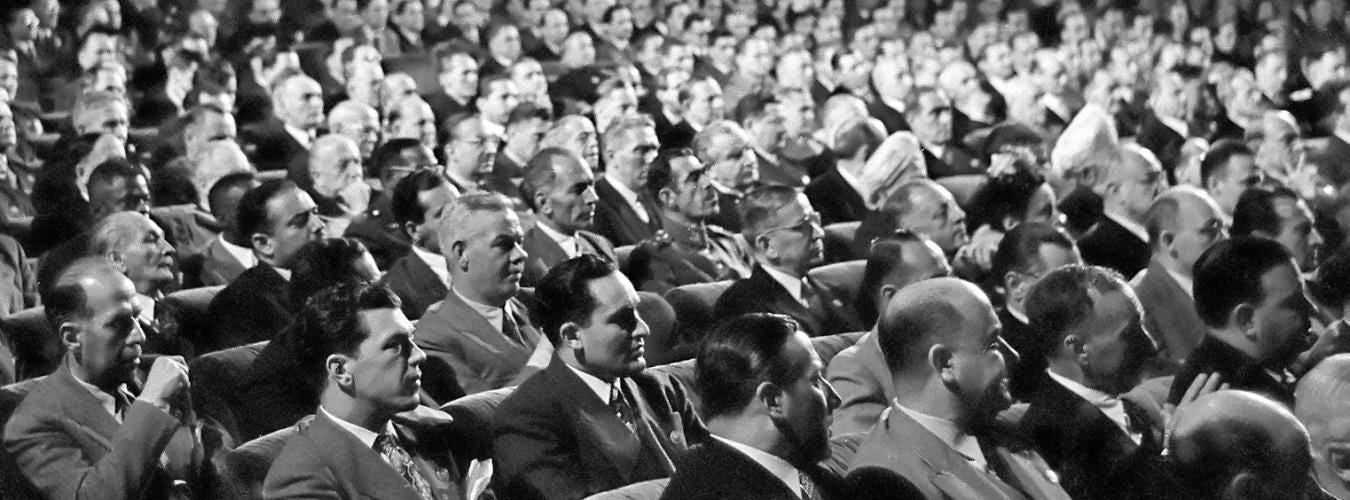
Indeed, as historians remind us, for two months before World War II ended—from 25 April to 26 June 1945—delegates of fifty nations met to charter the United Nations, which begins “We the peoples of the United Nations determined to save succeeding generations from the scourge of war, which twice in our lifetime has brought untold sorrow to mankind….” The Charter also requires “All Members shall settle their international disputes by peaceful means in such a manner that international peace and security, and justice, are not endangered” (Article 2, part 3).
Sixty years and two failed Senate confirmation attempts later, President George W. Bush made a recess appointment of John Bolton as U.S. Ambassador to the United Nations. The U.S. Senate did not confirm Bolton, in part, because Bolton spoke repeatedly over the years about how he thought the United Nations was irrelevant and that it only worked when the U.S. wanted it to work. President Bush reportedly thought the United Nations needed such a strong-minded diplomat. But despite Bolton’s service, he did nothing at the United Nations to improve his own opinion of the institution. And all these years later, Bolton is still saying the United Nations is “hopelessly broken.”
But the “everyday investigative watchdog” in me wonders why any journalism outlet is giving Bolton any space or time to opine about any topic other than the status of his federal grand jury indictment. Although the indictment is purported to be politically motivated because of Bolton’s criticisms of Trump, it comes only after years of investigation, including during President Biden’s administration, and discloses that Bolton shared top-secret information with relatives via an unsecured email account that was also reported hacked by “a cyber actor believed to be associated with the Islamic Republic of Iran.”
Yet in this 25 April 2026 NewsNation interview, for example, Bolton is given time to comment on the Trump Administration’s negotiations with Iran. Jumping on the bandwagon to interview Bolton is easy because he says controversial things like “I think the President’s lost. I don’t think he knows what to do next” (CNN 23 April 2026).
The harder work would be to report on how the U.S. and Israel have ignored the U.N. charter and that there’s a coalition of nations currently meeting to transition away from fossil fuels, the world’s reliance on which has energized this war on Iran.
That coalition meeting—the inaugural conference on “Transitioning away from Fossil Fuel”—was announced last November. Invitations then went out to nations. After that, open registration ran from 10-26 February and attracted over 2,600 organizations. The conference itself ends tomorrow.
But it wasn’t until today (in print, yesterday online) that The New York Times—with slogan ”all the news that’s fit to print”—reported on the conference’s existence (the online version I found too late to comment on because the online comments section had already closed). Given the late timing of covering the conference and the good-for-business framing of covering Trump, The New York Times story headlined how the Trump Administration had not been invited to the “Transitioning away from Fossil Fuel” conference. And, as if that were not enough bandwagon conducting, the newspaper also gave voice to the Administration’s position that the climate agenda is “bogus.”
Producing Records, International, National, and Local
In part, that view persists because conspiracy theorists in 2009 cited leaked emails (public records, but taken out of context) to conclude that the whole climate change agenda—the consensus of scientists worldwide—was bogus.
The aftermath of what was then termed Climategate (the conspiracy-fueled leak) led to at least one scientist spending half of his workday—for years—responding to public records requests: Dr. Benjamin Santer was a climate scientist at the U.S. Lawrence Livermore National Laboratory back then, and told me many of the records requests were needlessly complicated or technical, not made by scientists, and so likely meant those requesting the data and documents would not—or perhaps could not—do anything particularly meaningful with them. So Santer told me (and reporters at many journalism outlets) he came to think that the complexity and volume of public records requests were not about watchdog reporting but about keeping him from doing his job as a climate scientist. Then Santer sighed. I waited. He then told me that responding to public records requests was also part of his job—even as a climate scientist—because his employer was the people of these United States of America.
That employment status is true also of the President of the United States and those who are a part of the Executive Branch. And it was in response to the Watergate scandal—involving Nixon’s taped recordings—that Congress passed the Presidential Records Act of 1978. That law makes it clear that work, recordings, correspondence, et cetera even of the President belongs to the people, not to any individual in that office. The 1978 law also includes plenty of limitations on what constitutes a public record, how long before a record must be handed over to an archivist, and—even then—restrictions on what may be made available to the public.
But recently President Trump asked the Department of Justice whether the Presidential Records Act of 1978 is constitutional. In reply, the DOJ memo—released 1 April 2026—argued it was not. Since then, the Trump Administration is acting according to that memo rather than to the 1978 law passed by Congress.
Already a couple of lawsuits have been filed in federal court about it. Given past behavior of the Trump Administration and an analysis concluding an 80% success rate by the Trump Administration with “shadow docket” decisions from the Supreme Court, if a lower court rules against the Trump Administration in the lawsuits regarding his Administration’s record-keeping practices, it seems likely they will request the Supreme Court issue an emergency ruling.
“Our emergency docket should never be used, as it has been this year, to permit what our own precedent bars. Still more, it should not be used, as it also has been, to transfer government authority from Congress to the president and thus to reshape the nation’s separation of powers.”
— Justice Elena Kagan, 22 September 2025
Persistence
After the “How to Be an Everyday Investigative Watchdog” session at the Society of Environmental Journalists conference, I asked for the thoughts of those journalists who had experience reporting from authoritarian countries. They had very little to say. One of them told me “That advice doesn’t work for me where I report. But it sounds like it isn’t working for you, here, these days, either.”
I think it will eventually, with persistence and continued hard work. Independent journalists also do occasionally file lawsuits for public documents. But in the case of Jamestown, North Carolina, anyway, now even the (recently) elected officials are starting to act like watchdogs, too, of their own appointed officials.
(But we’ll see.)
What, if anything, keeps you from being a watchdog—monitoring institutions, politicians, and other public figures—in your habitat? Do you have local journalists to rely on for that service?
Appreciate this post but are thinking “No, I do not need another subscription, another newsletter, another micropayment to keep track of”? I get it. Please consider getting me a virtual coffee or contributing to my virtual tip jar.
Here's a tip.
https://www.theopennotebook.com/2026/02/26/announcing-the-retraction-watch-research-accountability-reporting-fellowship/
You might rather have the cash, though. ~:^{)>