

Economic Growth Versus Development
Growth can be malignant.

Today, JetZero broke ground on a $4.7 billion manufacturing plant at the Piedmont Triad International Airport locally here in North Carolina.
The state’s Department of Commerce touted the JetZero project as “the largest economic development project in North Carolina history based on job commitment.” But the project is really about economic growth (making the economy bigger) not economic development (making the economy better). And it is only economic growth if the company’s high-risk, high-reward design project is successful.
Prioritizing economic growth over economic development has resulted in many instances of malignant growth, in which the rich get richer, including instances when politicians don’t intend it, further raising inequality.
“In these conditions,” Guardian columnist George Monbiot reminded us in 2022, “it is easy for demagogues to blame the frustration of people’s hopes on scapegoats: women, asylum seekers, Muslims, Jews, black and brown people, disabled people, LGBTQ people, unions, the left, protesters” with such transfers of blame “open[ing] the door to fascism.”
Prioritizing economic growth (bigger) versus development (better) also often pollutes our environment with some wits as far back as the 1970s “have gone so far as to say that GNP [Gross National Product] means gross national pollution.”
AeroSpace Race
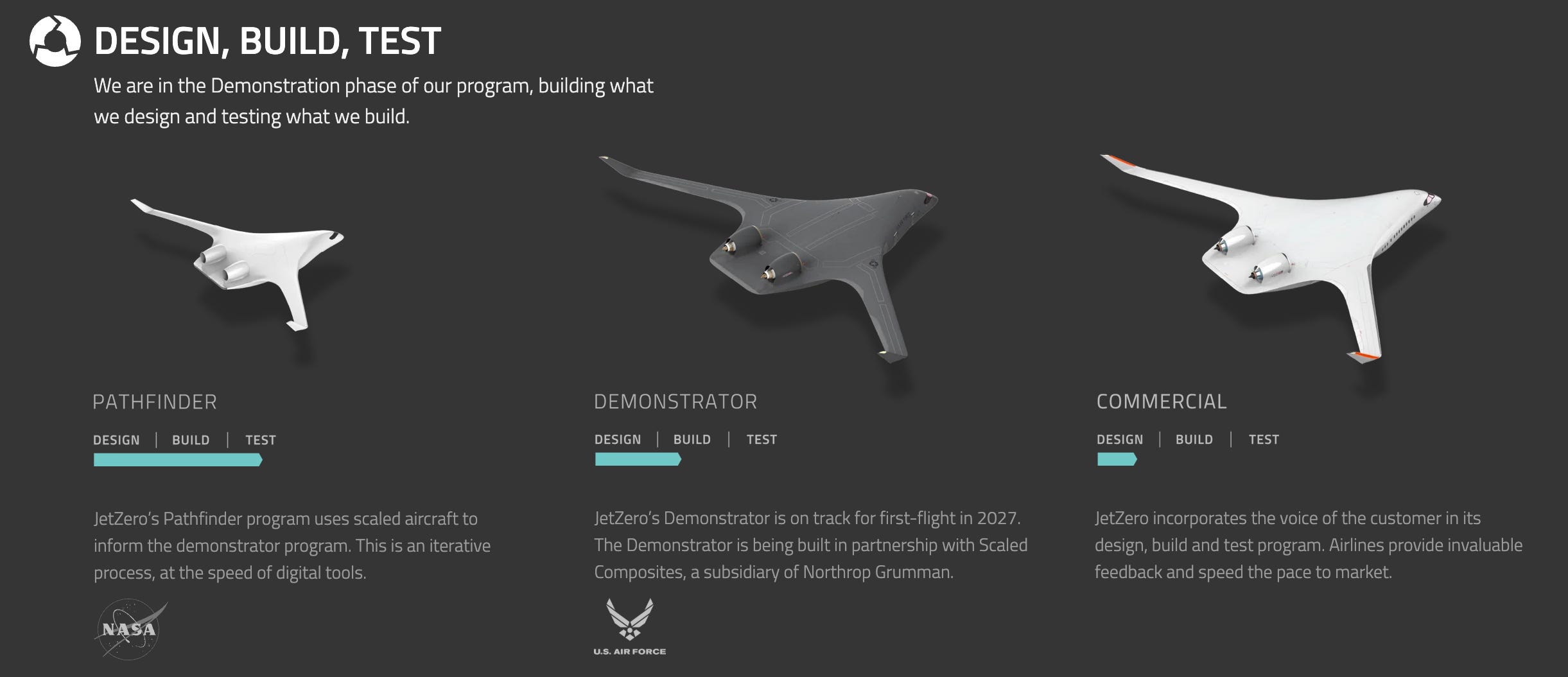
JetZero’s goal, says the company’s Dr. Ravi Chaudhary, is to “deliver the world’s first commercial blended-wing body airplane.”
Why?
A blended-wing design is far more fuel efficient than the tube-and-wing design of existing commercial airliners. JetZero estimates its planes will use 50% less fuel to transport roughly 250 passengers a range of 5,000 nautical miles, which is about the distance from Paris to San Francisco.
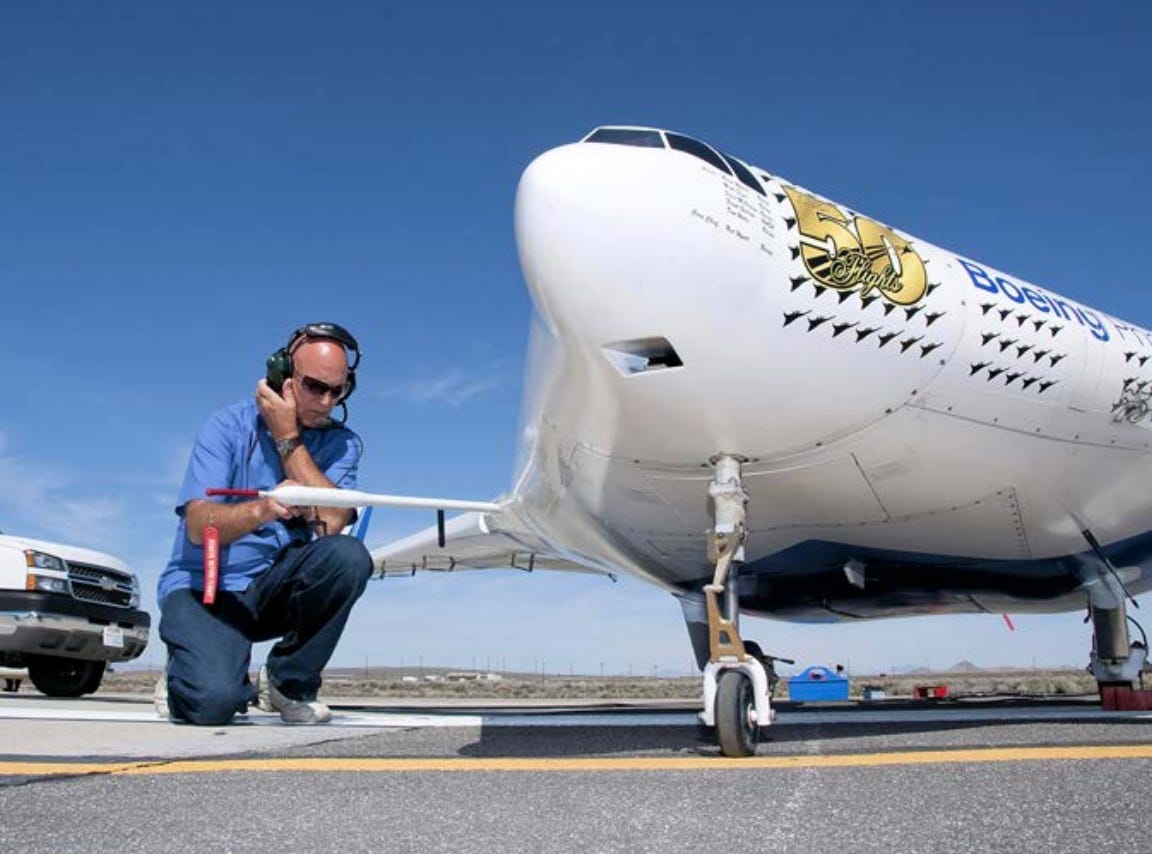
But there are lots of engineering reasons why the blended-wing design—first described in 1910—only recently got off the ground: The design requires both new engineering and materials for a safe, pressurized cabin, an invention first commercially available in 1938 that makes flying at high altitudes possible, which is particularly nice for avoiding travel through storms. The more typical tube-and-wing airplane design has a circular cross-section, the best shape for distributing uneven pressures inside and outside the plane. So for its non-tube shape, JetZero has partnered with Scaled Composites to use carbon-fiber reinforced composites.
At the same North Carolina airport, another high-risk-high-reward project, Boom Supersonic, completed construction of its manufacturing plant in 2024, but it has since sat idle. The company has been raising funds instead to use its engines, which are still under development, to act as electricity generating turbines, powering A.I. data centers by burning natural gas. Such fossil fuel use by just 11 new data centers — reports Wired (on Earth Day, 22 April 2026) — has the potential to emit more greenhouse gases than entire nations.
But whether air travel’s commercial future includes more efficient, blended-wing flight or the return of traveling at supersonic speeds, the benefits only go to those who can afford air travel in the first place while the costs affect us all.
Indeed, although the airline industry is proud of having increased air traffic (an average increase of 4.5% per year since 1990) without a corresponding increase in the greenhouse gas emissions (CO2 emissions self-reported up an average of 2% per year since 1990), the result of the increased traffic still means more greenhouse gas emissions. Add in individual choices—including choosing to fly business class, first class, or even in a suite—and that jacks up emissions even further.
The possible reintroduction of supersonic air travel via Boom Supersonic “consumes 2-3 times as much fuel per seat than comparable premium class subsonic travel,” which is double the trouble. That would wipe out any fuel savings gained by an equivalently sized fleet of blended-wing aircraft from JetZero, if a full-sized, pressurized cabin version ever gets out of the design phase. But it’s also possible that JetZero’s potential fuel savings would translate into less expensive air travel, prompting more people to fly (or, more speculatively, prompting the same people to fly more often), further boosting overall emissions because of increased air traffic.
What Is It Going To Take?
The idea that more information—or people being better informed—will help solve the world’s problems is no more true now with Hamas’s genocidal ideology than it was back when Hitler wrote Mein Kampf.
“Not every German who bought a copy of Mein Kampf necessarily read it … But it might be argued that had more non-Nazi Germans read it before 1933 and had the foreign statesmen of the world perused it carefully while there was still time, both Germany and the world might have been saved from catastrophe.”
— William L. Shirer, The Rise and Fall of the Third Reich (1960)
But as Nepal Times publisher Kunda Dixit put it in his book Dateline Earth: Journalism As If the Planet Mattered (3rd edition, 2023), “It will will be a formidable challenge to reform the world’s political and economic order, and ensure better governance and accountability, so that this [inequality] gap within and between nations can be narrowed. Journalists are a crucial link in the feedback loop ensuring that improvements in the quality of life can be sustained, and do not permanently damage nature.”
To that end, with President Donald Trump declaring yesterday a “deal” with Iran, the end of the U.S. naval blockade, and posting “Let the oil flow,” please consider these explicit questions part of a feedback loop regarding fossil-fuel dependent deals made in the name of “economic development” such as those made by North Carolina with JetZero and Boom Supersonic.
Are these deals really about making the economy better, or just bigger?
Who pays when high-risk, high-rewards deals fail, and who reaps when they succeed?
Are the community jobs gained by providing a high-end luxury item—such as supersonic travel that saves wealthy people a few hours on a transcontinental flight—worth the cost to our shared environment?
Is building more efficient, higher-risk airplane designs worth the fuel savings if the effect is to increase the number of flights and put greater demands on the production of more sustainable aviation fuel, swapping out food production for these kinds of biofuels?
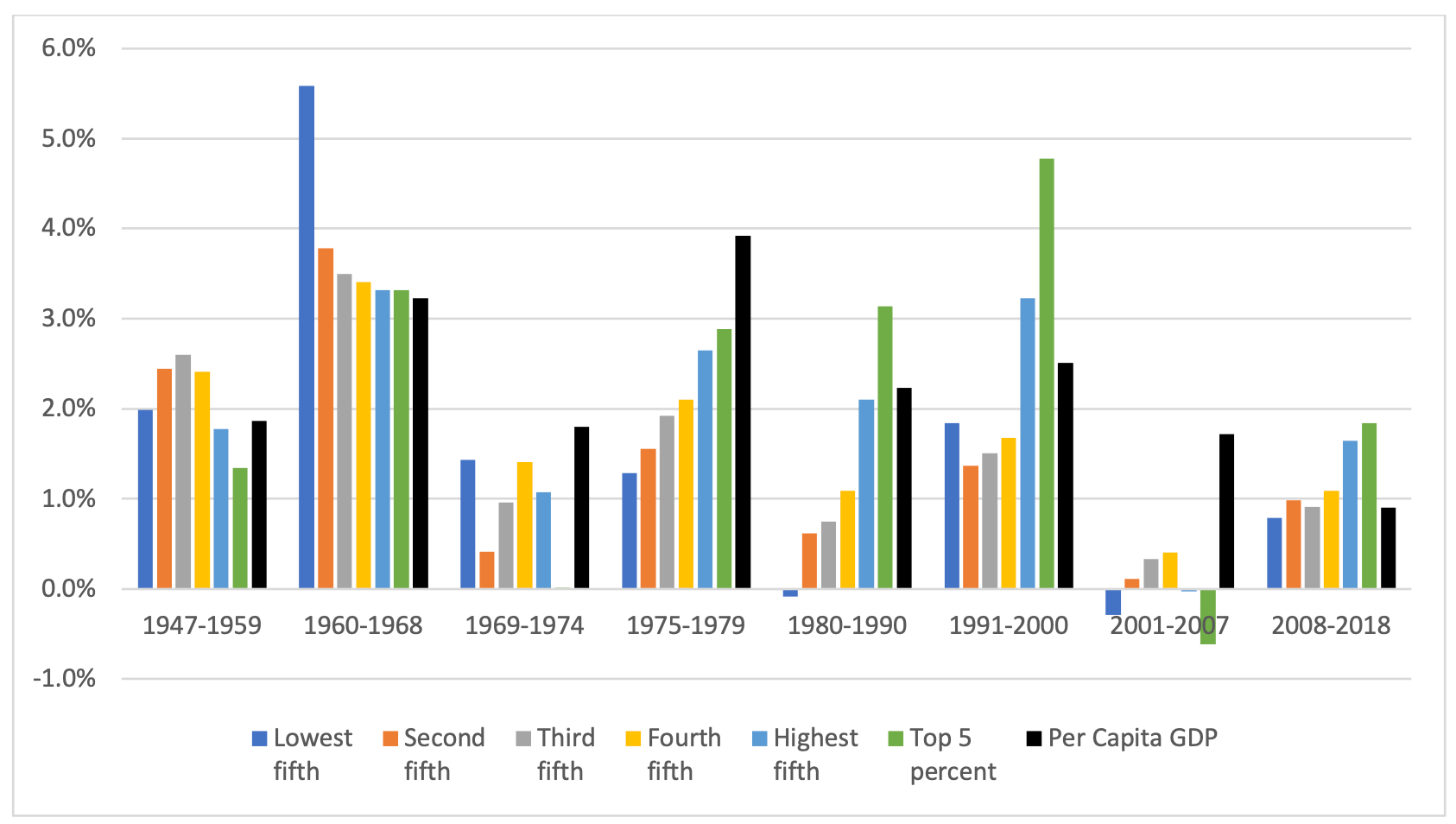
More broadly, when you look at a time when America was “great,” wasn’t it at a time when economic growth was better distributed across incomes — a time of economic development?
Appreciate this post but are thinking “No, I do not need another subscription, another newsletter, another micropayment to keep track of”? I get it. Please consider getting me a virtual coffee or contributing to my virtual tip jar. Thanks for your consideration.